Before I carried on with my game demo the lecturer showed us a video tutorial that showed how to create a waterfall environment in UDK, just incase any of us needed a reminder of the program.
For this session I focused on texturing my environment and even added a few extra areas including the detective agency and the club's hallway and floor layout. I was also able to add windows and doors to my scene.
Thanks to my friend Jim, I also discovered how to add a black and white filter to my game and thus make it look like the art style I intended the demo to be! I accomplished this by creating a box around my environment in which I then reduced the saturation of it to 1, thus making everything inside the area black and white.
You can see images of my work below.
Overall, while I am pleased with what I have accomplished, I feel that I could have done more today, altough this is probably just me being hard of myself as I forget that even though they is content within UDK that I can use already, creating my own assets will inevitably take longer. Combine this with my computer crashing at one point I shouldn't be too hard on myself.
Wednesday, 27 February 2013
Tuesday, 19 February 2013
Minecraft the story of Mojang (19/2/2013)
Unable to go see the movie 'Minecraft the story of Mojang' presented to my peers last Friday I decided to purchase it online and watch it at home. Basically this film follows the company Mojang and describes how they produced the game and how it was received by both the public and other game developers.
I didn't want to make too many notes as I wanted to pay as much attention as I could to the film. What I did write however, you can read below:
- Peter Molyneux advised that once your games' company reaches twenty employees then you may need to start making your work environment bigger and more like a large company. Therefore if you want to stay small/indie then stick with under twenty people. Peter also said that if he ever had the chance to restart in the games' industry then he would choose to be a small/indie company instead. Incidentally he went on to do this shortly after the movie was released.
- An actual Minecraft school exists that helps children learn to be more creative and know how to build a variety of things as you would in real life. The children have thus learned from playing this game how to build train tracks, music making machines, water irrigation systems, farms and even foundations for buildings. The teacher splits the children into groups and asks them to work together on projects in order to try and build anything from a house to a castle.
- With the above in mind maybe more kids could be taught through games. Perhaps video games will become a new teaching method as it can keep children engaged and improve their imagination.
- Sadly, I can't remember who said this but it went roughly as follows: "If you are going to take advice then do it! Otherwise you will never get round to doing it."
Thursday, 14 February 2013
Gender game doc and analysis (14/2/2013)
Task 1
(Three games and two movies with negative stereotypes):
- The Mortal Kombat series (1992-2011): The genders in this series have always had clear visual differences to one another as all the male characters are overtly muscular with six packs etc, whereas all the women appear slim and wear revealing outfits. Whether this is a indicator of the time it was first made in I don't know, but during the 90's it was common for video games and comics to be rather 'over the top' so as to appear 'bad ass'. However, why the developers haven't changed the appearance of the characters to be more gender appropriate for modern times I don't know, as the only changes seen are further details in the outfits the characters wear. Perhaps this because the developers wanted to stay faithful to their over the top series as most fans don't like change. Plus, as Mortal Kombat is set in both our world and a fantasy world the designs of the characters can be more elaborate as a result of the lore and history of the game worlds.
- The Call of Duty series (2003-2013): Originally I was going to talk about the Gears of War series, but since that has females taking part in the war as well as men I thought the Call of Duty series would make more sense to talk about as not only are women almost completely absent from their games, but the male soldiers are merely exaggerations of 'the real American hero'. Granted the Call of Duty series started off in World War 1 and 2 and therefore they wanted to be historically accurate by not having female soldiers, but this doesn't excuse the fact that you don't fight alongside any female soldiers in their Modern Warfare franchise. I recall a female pilot in Call of Duty 4 although, even then her role was to get rescued by the player when her helicopter is shot down. How a series can continue to have a lack of female roles seems to suggest that its popularity is mainly male, although I do personally know of one female friend who plays it constantly. The male characters seem to lose more and more humanity with each installment as they start to become 'tough guy' stereotypes instead of the jokey and loyal team based soldiers seen in the earlier World War settings.
- The Final Fantasy series and other RPG's (1987-2013): I have always been a huge fan of RPG's of any sort, but a recurring theme that I just can't seem to avoid noticing is the fact that in nearly every RPG the first female character in your party is nearly always the healer. Thus, whenever the first female character has joined my party all I can say is "Oh good! The healer has arrived!". This isn't me being sexist in any way, but out of knowing the troupes and stereotypes of such a genre.This is especially so in the Final Fantasy series as all the first female party members are healers. And whereas in the first couple of entries you could change your class, the White Mage (healer) was and still is most associated with female characters. Now having the ability to heal is greatly appreciated in games and nearly all players will make sure to have one in their party to keep them alive, thus making them a valuable asset to the team. However, it is a shame to see that the role of support and 'nursing' is always a female role. Of course, later female party members can usually fight better, but the most powerful hitter is generally a man. This is a shame as the first female party member never appears as a fighter nor is the role of healer given to a male character. Therefore, I hope one day that this changes as it would be nice to see a RPG being less stereotypical in terms of gender roles.
- Mortal Kombat The Movie (1995): A guilty pleasure of mine, Mortal Kombat the movie isn't great, but it is still a lot of silly fun and entertaining to watch. And, whereas the movie puts the characters into more appropriate clothing than the video games it is based on it doesn't always treat the female characters entirely fairly. For example, one of its plot holes which I recognised the first time I saw it was how the character Sonya ended up having almost a complete change of character near the end of the movie. Throughout the film Sonya is portrayed as a hard as nails cop, however, by the third act of the movie she is grabbed by her hair and dragged into a portal leading to another world screaming "Let me go!". This is odd considering we see her throughout the rest of the movie holding her own in numerous fights and winning. Granted this is only a video game based movie and they aren't sadly known to be very good. However, to have her character change so dramatically and suddenly need rescuing is nothing short of head scratching as it completely ruins her character, thus demoralising and demoting her to a mere 'damsel in distress'.
- The Transformers Movies (2007-2011): Being a huge fan of the cartoon series that the movies are based on I couldn't be more disappointed with these films. There are countless problems with them one of which is the fact that is uses the main female character played by Megan Fox as merely fan service for the audience as the camera angles around her in sexualised poses on bikes and car bonnets. In a way it is no different to black and white movies seen in the past that merely used the female characters for such reasons, something you would think most people would have moved on from in the 21st century. Probably Megan recognised too late that people were now only seeing her as as a sex object (she still gets type cast into these roles) went on to compare the director Micheal Bay to Hitler for his work on set! Of course hearing this didn't make him happy and therefore he fired her and replaced her in the third movie with Rosie Huntington-Whiteley. Rosie was meant to be a new love interest and character but ended up playing the exact same role as Megan Fox had before her. Therefore to see the actresses in these movies portrayed so inappropriately for both modern films and a franchise based on a child's toy just seems wrong in so many ways. I have never been one to like reboots, but if they ever thought about doing it for Transformers then I would say yes in an instants as so far these movies give the franchise a bad name and along with other races portray women very stereotypically.
Task 2
(Two hundred word game doc that portrays the stereotypes positively):
Below is the two hundred word game doc.
Set in modern times and following an
earthquake, the player plays as a couple who are geographically on opposite
sides of the country when the disaster occurs. They make their way out of
rubble and towards evac zones where they both look at photos of missing persons
and enquire if anyone has seen their partner. Unable to simply wait for their
partner to save/reunite with them they both decide to search for the
other.
My reason for choosing the above
idea was to enable both genders to be equally active and motivated to find each
other which better reflects a real life relationship; especially since it’s
established that the couple are married and love one another.
I did not want to represent a weak
woman in need of rescuing by a macho male.
The husband would be a nurse (traditionally
seen as a female role) and the wife would be a fire fighter (usually a male
role), thus the normally associated gender occupations are reversed.
Gameplay would be a side scrolling
plat former in which the player swaps between the partners and uses their
occupational skills and tools to complete puzzles such as healing wounds and fighting
fires.
Below is my explanation on the above image.
I wanted to get across both of the characters' careers in their designs and therefore dressed the wife in fire fighter gear as if she were on duty during the earthquake. I wanted to give her long hair so as to make it flow when she runs, suggesting fire flickering in the air. I gave her a fire axe in her left hand so as to psychically show she is able to use it and also uses a preferred left hand which most video game characters don't. I decided not to show damage to her clothes as I felt her uniform would protect her and she would most likely know survival skills in order to protect herself.
On the other hand, I dressed the husband as if he was off duty with only his nurses shirt under his jacket to identify him as such. I decided however that he should have at least a health pack on his back in order to show people that he knows first aid. I deliberately choose not to give him a stethoscope and/or a lab coat as I felt that would be too stereotypical. I also gave him glasses so as to show that he is an everyday man and made his clothes and hair look untidy as a sign of the event.
As for the pictures themselves, I wanted to tell a sort of story with them as you would see in a comic e.g. the couple standing next to one another, the couple then separated by the disaster and finally the couple reunited and holding hands.
Below is my explanation on the above image.
I wanted to get across both of the characters' careers in their designs and therefore dressed the wife in fire fighter gear as if she were on duty during the earthquake. I wanted to give her long hair so as to make it flow when she runs, suggesting fire flickering in the air. I gave her a fire axe in her left hand so as to psychically show she is able to use it and also uses a preferred left hand which most video game characters don't. I decided not to show damage to her clothes as I felt her uniform would protect her and she would most likely know survival skills in order to protect herself.
On the other hand, I dressed the husband as if he was off duty with only his nurses shirt under his jacket to identify him as such. I decided however that he should have at least a health pack on his back in order to show people that he knows first aid. I deliberately choose not to give him a stethoscope and/or a lab coat as I felt that would be too stereotypical. I also gave him glasses so as to show that he is an everyday man and made his clothes and hair look untidy as a sign of the event.
As for the pictures themselves, I wanted to tell a sort of story with them as you would see in a comic e.g. the couple standing next to one another, the couple then separated by the disaster and finally the couple reunited and holding hands.
Task 3
(Exploring gender aspects for my own game project):
As my game is set in a film noir world in the 1930's - 1940's, I could explore a lot of gender themes as it could cover how women were treated compared to men during this time.
As it is my game will have a female character who I plan to be a mysterious woman that you would usually find in such a setting e.g. able to hold her own and has a love/hate relationship with the main male role.
To contrast the above character I also plan on including another female character who whilst friendly works hard as a waitress taking orders from her customers who are mostly male. This isn't meant to be taken as sexist, it is only meant to be a sign of the times she is in.
I could further explore these themes in my game with how the NPC's react to one another within certain areas. For example, gentlemen in richer parts of the city would be more courteous towards woman, whilst say dock workers would wolf whistle at them and only see them as objects of desire.
Some of the women could be seen as traditionalists who don't want things to change whereas some could be more daring feminists in order to show a time of rising women's rights.
I understand that gay relationships would have been considered dangerous and unnatural by many people at that time, but I have no intentions at the moment of including this issue in my game, yet alone a gay support character unless their inclusion can be made relevant and not just thrown in for the sake of including that demographic. After all, if you are going to include gay characters then they should at least be treated with respect and not just added for the sake of it.
Wednesday, 13 February 2013
Gender and Agency Presentations (13/2/2013)
At the start of this session we looked at a presentation simply named 'Gender' that was deliberately made to poke fun at the stereotypical perception of men and women in games e.g. tough guys and happy girls. It was both rather comical and interesting as even though we laughed we also recognised the seriousness of the subject matter.
We were then given a task to do for after reading week in which we had to look at numerous examples of both good and bad gender characters presented in both video games and movies. I believe this was so that we would become more aware of the current gender stereotypes found within video games.
Afterwards we had a long presentation based on Agency that took up the rest of the lecture. It was an interesting one to say the least and therefore I took the following notes.
McMahon's 3 conditions for Immersion are as follows...
We were then given a task to do for after reading week in which we had to look at numerous examples of both good and bad gender characters presented in both video games and movies. I believe this was so that we would become more aware of the current gender stereotypes found within video games.
Afterwards we had a long presentation based on Agency that took up the rest of the lecture. It was an interesting one to say the least and therefore I took the following notes.
- How much control should the player have over their character? e.g. a blank slate or charatised.
- Don't have the character do pointless things unless it means something more e.g. 'Minecraft' in which things like digging which should be counted as a mundane thing is actually a big part of the whole game.
- When the player impacts on the in game world they feel greater agency (connection).
- Achievements and Trophy's can be an illusion of agency if they reward you for trivial things e.g. in 'The Sims' you have to buy furniture for your Sims to rest on, so to be given an Achievement/Trophy for buying one out of twenty available sofas is rather silly as it is something you need rather than being rewarded for something epic such as slaying a dragon.
- Hard games can be rewarding if they result in the player being able to overcome the set challenges, as they give the player great satisfaction for finally overcoming something difficult.
- There is a psychology within Facebook games as 'Farmville' keeps the player returning to play by explaining the rules before rewarding them for their actions. They further explain that, if they come back in around an hour then not only will their crops have grown, but their avatar will have enough energy to do even more things and even help out on their friends' farms, thus convincing those players to help out each other and get satisfaction from that.
McMahon's 3 conditions for Immersion are as follows...
- Users expectations of the game or environment must match the environment’s conventions fairly closely.
- User’s actions must have a non-trivial impact on the environment.
- Conventions of the world must be consistent.
Thursday, 7 February 2013
An audience with Richard Weeks (7/2/2013)
Having the opportunity to listen to advice from Richard Weeks (someone who has now been in the industry for twenty years) and even learn a thing or two about the industry made me want to listen to his talk.
I didn't record this session as it was being filmed, however, I did get down the following notes:
After Richard Weeks had finished speaking he then answered questions.
I asked "What is your advice for those of us who want to go into the development of stories and characters?".
His response was that writing is one of the (if not the most) difficult areas to get into within the industry as often companies will only accept well known writers. If they are looking for writers then most of the time they will give you a setting and/or a genre and you will have to create a story for that game. Sometimes the story comes after the initial start of the game play mechanics. Therefore try and challenge yourself into writing a story out of pre-given examples, whether from friends or family. This technique will help you gain experience in this field and will make you think outside the box. You can also write down the concepts for characters well in advance as you could then put them into new genres and have their personality tell the story in different ways.
Richard Weeks even went on to say that he would be more than happy to hire us in our later years providing we fit the requirements he is looking for. He's also willing to keep in contact with any of us by email should we wish to ask him anything.
For those of you who don't know what Richard Weeks looks like you can see a picture of him below:
I didn't record this session as it was being filmed, however, I did get down the following notes:
- He worked for Lucasarts in team projects of 60-100 people a title.
- He was working on 'Knights Of The Old Republic III' for the Xbox 360! Sadly it got cancelled.
- May have to get used to the fact that you may not get employed for a while. Therefore use your spare time in order to keep yourself busy.
- During the 80's it was considered weird to play video games if you were old. Then in the 90's the PlayStation was released and it became more common for anyone to play games.
- Choose the type of company you want to work for. Big company with sensible but safe ideas? Or Indie ones with out there but uncertain ideas? Big companies will be unlikely to fire you whereas Indie companies have the risk of collapsing.
- Make links to any playable games you have made on your blogs.
- Expect very, VERY long hours. Between 70-100 a week and that includes overtime that you are unlikely to be paid for. Therefore try and enjoy your work and if you don't like the project you are on then try and find an aspect of it that you can enjoy.
- Research your company and make sure they don't have any horror stories as it were e.g. not paying employees etc.
- Keep money in your bank. Just if you need to leave the country to work aboard then its useful. Plus it can REALLY help in later years when you struggle to find a job or build your own company.
- You may end up a 'cog' in the industry. e.g. following the rules and doing as you are told. You may be able to throw in ideas from time to time, but not every company works that way.
- Learn to work in a team and always be friendly.
- Don't believe everything you hear! Form your own opinions and try to stick with them.
- ALWAYS READ YOUR CONTRACT! Just some companies may try and own your own ideas and games if you leave them!
- Within the art side of the industry you give in your work and they say which styles they want you to continue with.
- Bugs and faulty save points are the biggest reason for games being called back.
- Go to as many gaming events as possible. Try and get your name out there and don't be afraid to introduce yourself to others.
- If you want your own company then you seriously need to save your pennies. You may even have to share a flat or house with your coworkers. Therefore side jobs are very useful as well as they make sure to bring in some money to live on at least.
- If you can work with those you know in order to have fun whilst releasing something that has your name on it.
- Tiny games aren't a bad idea either. Challenge yourself to make a game in two weeks and see how it turns out. If its good then you may be able to sell it online, otherwise if its just average then put it online for free and see what responses you get. It's all good learning opportunities at the end of the day.
- Always make sure your CV looks good! Cover letter needs to look good as well in order to get the reader's attention which is HUGELY important.
- Follow your heart. Is it money you want which isn't a bad thing or unique games which are challenging, but rewarding.
- If you are happy where you are in the industry then that's fine. Don't feel forced into climbing the ladder as it were.
- Mix up your CV! Create different ones for different companies and link your blogs and any made games to them.
- Enter as many competitions as you can.
- Put down how many people you worked with in previous projects. This shows the reader that you can work with others and the higher the number the better.
- Role play games such as 'Dungeons and Dragons' are often how new mechanics and even ideas for new RPG's are made up. Therefore anyone who does play them should continue to do so as they are a lot of fun and will help you think of what type of experiences you want to share with your players. They also greatly improve your imagination.
- Show flare in your CV e.g. spice it up by giving it a background image similar to the 'Space Invaders' one he received in the past.
- Make your games slick. Bad controls = a bad game.
- For your starting game you should NEVER make a shooter as they require a lot of work and can be narrowed down to only fans of shooters. Also, fans of this genre expect a lot as they have played other popular action packed and balanced shooters. If your game can't do this then many may see it as a bad game.
- Make sure to get your name on the credits of everything you do.
- Get in contact with people. They can be surprisingly helpful.
- Getting a full time contract sadly takes a very long time.
- Make business cards and give them to others in the industry you meet. Make sure they have your blogs and email addresses on them.
After Richard Weeks had finished speaking he then answered questions.
I asked "What is your advice for those of us who want to go into the development of stories and characters?".
His response was that writing is one of the (if not the most) difficult areas to get into within the industry as often companies will only accept well known writers. If they are looking for writers then most of the time they will give you a setting and/or a genre and you will have to create a story for that game. Sometimes the story comes after the initial start of the game play mechanics. Therefore try and challenge yourself into writing a story out of pre-given examples, whether from friends or family. This technique will help you gain experience in this field and will make you think outside the box. You can also write down the concepts for characters well in advance as you could then put them into new genres and have their personality tell the story in different ways.
Richard Weeks even went on to say that he would be more than happy to hire us in our later years providing we fit the requirements he is looking for. He's also willing to keep in contact with any of us by email should we wish to ask him anything.
For those of you who don't know what Richard Weeks looks like you can see a picture of him below:
Referencing:
- Unknown (Unknown) Richard Weeks [Online image]. Available at: http://totalmonkery.com/wp-content/uploads/2012/08/richardheadshot.jpg (Accessed: 7/2/2013).
Wednesday, 6 February 2013
Game Project Part 4 and Flow in Gaming (6/2/2013)
For this session we were shown more videos based on how to design effective game environments.
Points included:
We were also asked to look up the definition of 'flow' in gaming for next week.
You can find out what I discovered below:
It appears to suggest that flow is the perfect balance of game play and how making a challenge too easy makes us bored, whereas making a challenge too hard makes us rage. Therefore flow is the perfect balance of both, putting us into a state of enjoyment that focuses on the game play completely and not on any of the outside thoughts or worries we may have. It is also important that what we are doing is clear, achievable and responsive in some way or form, otherwise we don't get the sense of satisfaction from overcoming the challenges presented in the game. Also, if we don't feel as if we are in control of the experience or cannot concentrate on the game play itself then this can kill flow as well.
I used the following website as my means of finding out about 'flow' and feel that it is a good one that is certainly worth a read if you want to look into the subject in more detail.
Points included:
- Who, what, where and why? Try and include these in your planning.
- What type of environment is it? e.g. city, forest, mountain etc.
- Where is it set? e.g. London, Amazon, Arctic etc.
- What game type is it for? e.g. capture the flag, team death match, racing etc.
- Once you have figured out the above then you can get round to making an experience which feels like a whole package and not just thrown together.
We were also asked to look up the definition of 'flow' in gaming for next week.
You can find out what I discovered below:
It appears to suggest that flow is the perfect balance of game play and how making a challenge too easy makes us bored, whereas making a challenge too hard makes us rage. Therefore flow is the perfect balance of both, putting us into a state of enjoyment that focuses on the game play completely and not on any of the outside thoughts or worries we may have. It is also important that what we are doing is clear, achievable and responsive in some way or form, otherwise we don't get the sense of satisfaction from overcoming the challenges presented in the game. Also, if we don't feel as if we are in control of the experience or cannot concentrate on the game play itself then this can kill flow as well.
I used the following website as my means of finding out about 'flow' and feel that it is a good one that is certainly worth a read if you want to look into the subject in more detail.
- Chen, J. (2006) Flow in Games. Available at: http://www.jenovachen.com/flowingames/flowtheory.htm (Accessed on: 6/2/2013).
Friday, 1 February 2013
Game Project Part 3 (30/1/2013)
When our lecturer decided to show us a video on how to design effective game environments, I made sure to take notes that could prove useful since I had already jumped into the development of it without any previous planning.
You can read my notes below.
After I had finished with the art tablet I had borrowed from Resources, I spoke with the man there who told me that they supplied good voice recording equipment which would only record your voice and wouldn't make any popping noises as you sometimes get. This was great news as if I ever wanted to include voice acting in my project (as I am interested in doing as a future side career) then I could borrow this equipment.
References:
You can read my notes below.
- See EVERYTHING as a game environment waiting to be made.
- Take a small art book with you wherever you go so as to record what you see.
- Taking pictures of anything for inspiration will also allow you to put them onto programs such as Photoshop and for example, by using a dark silhouette of a person you can make anything massive like a mountain or something as tiny as whats under a bush look like a game environment. You can then add to these images cropped pictures of statues and other things in order to adjust the scale of the scene. e.g. using a statue's head within a bed of flowers could make the statue's head look similar in scale to the Statue of Liberty and therefore make the flowers look as if they are gigantic (maybe this could be a setting for a sci-fi game?).
- Mix and match images in order to create new themes and genres if you can.
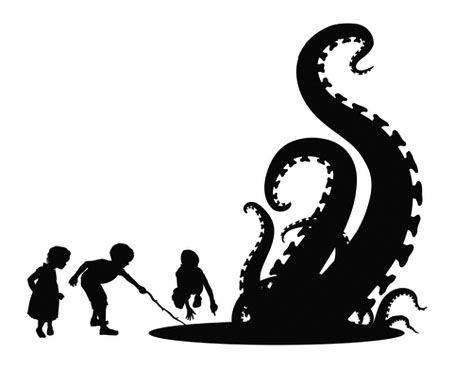
After making notes for the video I then went onto creating a personal collage that would capture the mood of my game.
After
finding a background that would suit the era, I gathered an image of Cthulhu
and a great image of some kids playing with a monster. I then decided to use
one of the silhouettes for my art project as it was meant to be a
private detective and therefore as a result fitted the scene nicely.
Reducing
the contrast and brightness of everything I was able to make it not only fit
the black and white filter that the game would have, but also create the
intended atmosphere that I wanted for my game.
After I had finished with the art tablet I had borrowed from Resources, I spoke with the man there who told me that they supplied good voice recording equipment which would only record your voice and wouldn't make any popping noises as you sometimes get. This was great news as if I ever wanted to include voice acting in my project (as I am interested in doing as a future side career) then I could borrow this equipment.
References:
- Ovchinnikov, A (2010) Children’s Illustration [Online image]. Available at: http://www.johncoulthart.com/feuilleton/wp-content/uploads/2010/01/ovchinnikov.jpg (Accessed: 23/1/2013).
- Unknown (2008) Film Noir at West Court Street, Version 1 [Online image]. Available at: http://farm4.static.flickr.com/3275/2361011916_3eeeac622b.jpg (Accessed: 23/1/2013).
- Unknown (Unknown) Cthulhu Silhouette [Online image]. Available at: http://www.mu-podcast.com/images/Spawn_of_Cthulhu_Silhouette_left_199.png (Accessed: 23/1/2013).
Subscribe to:
Posts (Atom)